
History and purpose of the Campaign
Justice on the Rails!
People’s life and the Vale Company along the Carajás Railway
Proposing an action to claim justice and respect to the environment
www.justicanostrilhos.org
1. History/Context
The region in Brazil known as “Carajás” is a mineralogical province located in the Western Amazon. It was discovered by multinationals companies at the time of the dictatorship military and contains the world’s largest reserve of iron ore of a high content, considerable reserves of manganese, copper, bauxite, nickel, tin, and others minerals resources beside a vast possibility of forest exploitation, farming, cattle-breeding and an enormous hydro-electrical power.
The searching for iron ore in the Serra dos Carajás, which is located in the East of Pará state, began in the 60’s and was increased in the following decade when the State mining Company Vale do Rio Doce (Vale) took upon itself the total control of mineral resources in the region and created in 1979 the Programa Grande Carajás (Great Carajás Program) aiming to produce minerals on an industrial scale to supply the international market.
In order to consolidate this very big project it was necessary to develop infra-structure works of great impact, as for example the Tucuruí Power Plant, which is located in the Southeast of Pará state, the Madeira Port in São Luis in the Maranhão state (this is the busiest loading port in the North-Northeast), and the Carajás Railway, amongst others.
The Carajás Railway
The Carajás Railway was inaugurated in 28 February 1985. It has 557.5 miles of extension (892 km) and crosses 25 small towns (4 in the Pará state and 21 in the Maranhão state) linking up the mineralogical province of Carajás, in Pará, with the Port of Ponta da Madeira, in São Luis. It is directly operated by the Vale do Rio Doce Company (Vale) through a concession made by the Brazilian State in 1976 and later renewed, in 1997, for another 30 years, just after the Company was privatised.
With excellent technical conditions, the Carajás Railway is amongst those with the best indices of productivity in the world, which makes it a fundamental railway for the growing high profit obtained by the mining Vale Company.
Besides the iron ore and manganese, the Carajás Railway transports yearly tons of others minerals together with products such as wood, cement, drinks, vehicles, fertilizers, petrol, products of siderurgy and of agriculture, particularly the Soya that is produced in the South of Maranhão, Piauí, Pará and Mato Grosso states.
Such a big enterprise has redesigned a very important part of the Amazon landscape, has favoured new economic activities (for example, the siderurgy), besides provoking a turnover in the life of the local population, especially in the life of the indigenous people.
Despite not being one of its priorities and to comply with its obligations imposed by the concession agreement, the Vale Company transports also passenger through the Carajás Railway. However, what would appear to be a benefit for the local population, has actually generated many problems due to the big amount of people who often take the train in Maranhão state and move down searching for work opportunities in the Southeast of Pará state. Since they have no qualification to carry on any specialized task, they are, therefore, fated to fail. Besides this, delays and the occurrence of accidents and run downs are quite common along the railway.
The situation gets worse when it is considered that the Carajás Railway is in plain process of becoming a dual railway all along of its extension aiming to reach 100 millions tons/year in 2010. This has led to the enlargement of railway courtyards, diversion and terminals for the composition of trains with three engines and 312 railway wagons. All this tends to generate impacts even bigger on the environment and on the life conditions of the people who live along the railway.
Present Context
The great mineralogical pole of Carajás is currently the world’s largest mineral and metallurgical complex. Along the Carajás Railway there are 14 siderurgies concentrated in a ray of 15 miles (150 km). They are mainly installed in the regions of Marabá, in Pará state, and in Açailândia, in Maranhão state. The iron ore is exported (100% in the particular case of various siderurgies) to the American, European, Chinese, and Japanese markets.
Each siderurgy may consume over 300 tons of charcoal a day. This contributes enormously to the deforestation of the region: at present the native forest areas in the region are almost inexistent.
This economic model is destructive, because it employs very few people in comparison with other possible ways of utilizing the land, it concentrates money and power in the hands of few investors of the region, it does not allow any kind of debate regarding possible alternatives, and affects people’s health through the emission of extreme pollution.
It is worth mentioning that the Vale is currently the leading company in fine notification by the Brazilian Institute for the Environment (IBAMA). This organ is responsible for the environmental protection at a national level. Since its privatization, the Vale Company got 56 notifications of environmental infractions. That corresponds to the amount of R$ 37 millions (in Real, the Brazilian currency) in fines. This kind of notification normally results from the non-accomplishment of the conditions imposed at the moment of issuing the environmental license.
In alternative to this multinational giant, small alternative experiences are being developed at a grassroots level: courses and initiatives on agri-ecology which is linked to the familiar production in the settlements, experiences of local commercialisation in rural-urban areas, recycling projects, and small alternatives productions within the towns. There would have a wide range of opportunity to promote micro-credit.
Although there has been a modern infra-structure that favours new industrial activities, there has prevailed in the region the concentration of income, of lands, and has also advanced the process of social exclusion, if taken into consideration the low economic return to the country and fundamentally to the local populations. Under a false image of a developing progress, there operates the plundering of resources on behalf of private and foreigner interests keeping the eagerness of the hegemonic nations governed by the law of market in detriment of the destruction of the State and of the annihilation of the Brazilian people.
The emblematic case of Açailândia
Açailândia is a strategic town for the Vale Company for it is in Açailândia, in the interior of Maranhão state, that the Carajás Railway is connected with the North-South Railway. The enlargement of this last one, which intends to link the city of Goiânia, in the state of Goiás, to the city of Belém, in the sate of Pará, is a big infrastructure project in Brazil to which priority has been given for it construction is for the benefit of the agribusiness.
Also in this town the Belém-Brasília Motorway (BR-010) meets up with the 222 Motorway (BR-222), which goes from Fortaleza, in the state of Ceará, down to Marabá, in the state of Pará.
The population of Açailândia has been in its great majority victim of various forms of environmental degradation. Açailândia has become an emblematic case amongst all the towns through which passes the Carajás Railway for it condenses in only one area different kinds of situations which compromise the wellbeing of the population (mining, deforestation, eucalypt monoculture, pollution caused by the siderurgy and charcoal-factories, slaved work, malnutrition, and children sexual exploitation). We are dealing with an expressive context of an entire region (Carajás) whereby the problems are very similar and people’s power is quite disproportional to that of the local acting big business companies.
2. The Campaign
The “Justice on the Rails” Campaign began in the end of 2007 through the initiative of the Comboni Missionaries (a Catholic Church Religious Congregation), who have been working in diverse regions of Maranhão state, and rapidly was joined by others groups and social organisations which now compose both its executive coordination and networked actions.
We have taken as priorities the defence of the environment and of the Amazon threatened local populations, especially those people living along the Carajás Railway. The Campaign intends also to draw attention to the damages caused to the local indigenous people and to the labourers who are victims of exploitation.
The Campaign is being carried out involving strategically three segments of society: the popular movements and the basis of the population, universities, and the local public institutions.
We intend to take the opportunity of the World Social Forum (to be held in Belém, January 2009). The occasion of the WSF may offer a bigger visibility to the grave situation of the region and to give a contribution for the establishment of ample alliances at local and international levels; this experience of pressure on the Vale Company in the Carajás setting may also become a model for others regions.
The objectives of our action are mainly the following ones:
a) To evaluate the real impacts of the activities carried out by the mining Company Vale do Rio Doce (Vale) along the so called influence area of the Carajás Railway;
b) To propose a debate on the construction of mechanisms that makes possible the application of resources of the Vale in a way that the sustainable development of the local communities may be stimulated.
It is worth mentioning that up to the moment of its privatization the Vale Company had the obligation to contribute towards a Developing Found which was in force while the Company belonged to the State. The Vale was obliged to repay 8% of its invoicing to this Found to be invested on behalf of the populations that were directly affected.
The obligation to contribute with this Found, however, was ceased with the privatisation of the Company. Since then, through a Foundation, the Vale has adopted a policy of “social improvements” by developing small local projects with the application of funds absolutely disproportionate to the annual high profits of the Company and without any obligatory and permanent commitment with the local population.
There glimpses the possibility for the local populations and public administrations to demand compensations and royalties according to the effects of the social and environmental impacts caused by the cycle of mining activities. This process, which may lead to a Term of Adjustment of Conduct, could result in the creation of a Developing Found, which would be supported by both the State and the Vale Company and equally administrated by the civil society for environmental and social investments (in the area of agri-ecology, reforestation of native species, subsidies for the familiar agriculture and cooperatives, for the recovery of rivers and streams, etc.).
The Campaign is being worked through the year 2008 in diverse directions:
– Study and research (data-collecting on environmental impact caused by the Carajás Railway, documentation of the damages caused on the people and the soil, environmental laws and partnerships of the Vale Company with the cities crossed by the Carajás Railway, comparison of the social and economic situation in the region of the Carajás with other similar in Brazil and abroad, analysis of the economic and countable data of the Vale, etc.)
– Consciousness and mobilization of the people (realisation of seminars, production of material of propaganda, small TV documentaries, booklets, page on the internet, formations meetings, etc.)
– Strengthening of the network for action that involves interested groups and movement both at national and international levels
A coordination team composed by representatives of social organizations, lawyers, judges and others professionals, Professors and university researchers have already taken the first steps of this work. Join this struggle for justice and for an equal share of the earth goods for the life of the people and the environment along the Carajás Railway!
The Coordination of the “Justice on the Rail” Campaign.
Contacts:
www.justicanostrilhos.org
justicanostrilhos@gmail.com
0xx99-3538.1787
0xx99-8112.8913
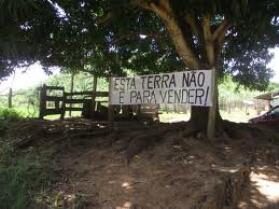
 Dessa forma, Canaã dos Carajás teria daqui a três anos uma população de 27.400 mil trabalhadores desempregados, quase o número de sua população atual. “Isso não é geração de emprego, pois não há perenidade nessa relação empregado-empregador, além de termos o equivalente a outra Canaã desempregada”, salienta Cruz.
 Além disso, o direito de ir e vir dos camponeses bem como seus costumes serão prejudicados. “Várias estradas serão desviadas e terão a ferrovia para atravessar, o que aumenta o risco de acidentes, sem contar nossos valores que passam a ser alterados pela mudança das coisas”, reclama o agricultor Erinalvo Ribeiro.
 A Vale, cujas reservas estão em posição geográfica fragilizada em face de seus principais competidores, se encontraria pressionada a buscar inovações tecnológicas e organizacionais voltadas à redução dos custos logísticos.
 “Conforme parecer emitido pelos técnicos da Secretaria de Meio Ambiente de Parauapebas, pude constatar que os estudos apresentados para elaboração do EIA e do RIMA, documentos imprescindíveis para obtenção do licenciamento ambiental, foram executados no ano de 2006, ou seja, há mais de sete anos, período em que muitas transformações ocorreram em nosso município e região”, reclama Soares.


Comentários